
Shukla said the two missions presented a major opportunity for the country and the sustained commitment of the government to the space sector, despite setbacks such as the Chandrayaan-II mission was laudable.
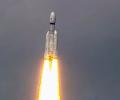
The Chandrayaan-3 mission that aims for a soft landing on the moon's surface, paving the way for future interplanetary missions, carries six payloads that would help ISRO understand the lunar soil and also get the blue planet's photographs from the lunar orbit.

Chandrayaan-3 mission's rover 'Pragyan' has traversed a distance of about eight metres on the lunar surface, and its payloads have been turned on, ISRO said on Friday.

Lucknow celebrated the successful return of astronaut Group Captain Shubhanshu Shukla from the International Space Station (ISS). Family, friends, and the community rejoiced as Shukla, the first Indian astronaut to visit the ISS, made a successful splashdown in the Pacific Ocean.

If it wasn't so violent, there would have been a few unintended laughs in Baaghi 4, but this one has not a shred of humour amidst the nonstop mayhem, observes Deepa Gahlot.

After the successful landing of Chandrayaan-3 on the Moon on Wednesday, August 23, Bollywood has joined India to laud ISRO (Indian Space Research Organisation) and its team for the historic mission.

The mission objectives of Chandrayaan-3 are to demonstrate a safe and soft landing on the lunar surface, to demonstrate rover roving on the Moon, and to conduct in-situ scientific experiments.

Four decades after America's last landing on the Moon, new images from National Aeronautics and Space Administration's camera have shown that all flags except one planted during Apollo missions are still standing and waving, despite the harsh lunar climate.

After the successful deployment of Chandrayaan-3's lander and rover on the moon, Indian Space Research Organisation (ISRO) is hoping that their mission life will not be limited to one lunar day or 14 earth days, and that they will come back to life when the sun again rises on the Moon, to carry on with the experiments and studies there.

ISRO to launch a 6,500 kg communication satellite built by the US, marking a significant milestone in the Indian space program after the successful launch of the NASA-ISRO NISAR mission.
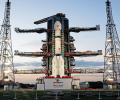
The imaging technology in Nisar can provide very high-resolution data on changes as small as one centimetre in size on the earth's surface.

India's lunar mission Chandrayaan-3 holds immense potential for gathering critical data and will significantly contribute to the understanding of the Moon, a former top National Aeronautics and Space Administration (NASA) official has said, describing India-United States space partnership further moving to the moon.

Russia's state space corporation, Roskosmos, according to the Reuters report, said it had lost contact with the spacecraft shortly after a problem occurred as it was shunted into pre-landing orbit on Saturday.
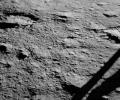
Speaking to PTI, Somanath said, "(The lander landed) perfectly in the intended site. The landing location was marked as 4.5 km x 2.5 km -- I think on that space, and the exact centre of that was identified as the location of landing. It landed within 300 metres of that point. That means it is well within the area identified for landing."

As India successfully lands Chandrayaan-3, does the moon look as beautiful as one's beloved or has the Chanda Mama of folk ditties acquired a whole new meaning?
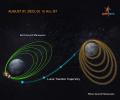
The ISRO had said it would attempt softlanding on the lunar surface on August 23.
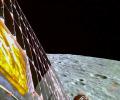
As scientists at the Indian Space Research Organisation (ISRO) gear up for the much-awaited soft landing of the Chandrayaan-3 spacecraft on the Moon's surface, the space agency may postpone the touchdown to August 27 in the event that health parameters of the lander module are found to be "abnormal", a senior official has said.

India's ambitious third Moon mission's spacecraft Chandrayaan-3 after the launch on July 14, had entered into lunar orbit or the Moon's orbit on August 5.
Chandrayaan-1, India's first mission to the Moon, was launched on October 22, 2008 from Sriharikota spaceport in Andhra Pradesh.

Announcing that the health of Chandrayaan-3's Lander Module is normal, ISRO on Friday said that the module has successfully undergone a deboosting (slowing down) operation, taking it closer to the Moon.

The rover will carry out in-situ chemical analysis of the lunar surface during the course of its mobility.

Group Captain Shubhanshu Shukla, India's second astronaut, shares his journey from a shy child hearing stories of Rakesh Sharma to becoming part of the Axiom-4 mission to the International Space Station. He emphasizes the role of the IAF in his transformation and inspires India's youth to explore space.
Mainstream American newspapers, many of which had been sceptical of India's space mission and sometimes even made fun of it through cartoons, noted the great Indian achievement.

So, if ISRO is able to revive them as the Sun rises on the Moon again, information that is derived from experiments that could once again be conducted by the Chandrayaan-3 payloads would be a "bonus".

The ISRO chief further said that the ISRO is ready to fulfill the vision put forth by Prime Minister Narendra Modi.
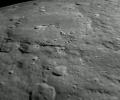
The team led by researchers from the University of Hawai'i (UH) at Manoa in the US discovered that these electrons in Earth's plasma sheet are contributing to weathering processes -- breaking down or dissolving of rocks and minerals -- on the Moon's surface.

Even as the scientists and staff at Mission Operations Complex broke into applause, the core team members thanked all those who had worked on the mission. Quietly and without jingoistic boasting of their stupendous achievement. And that is the most remarkable aspect of ISRO -- they let their work do the talking, notes Minnie Vaid, author of Those Magnificent Women And Their Flying Machines, ISRO's Mission to Mars.

The race to the uncharted south pole of the Moon is quickening with India's Chandrayaan-3 and Russia's Luna-25 gearing up for lunar landings next week, each mission holding significant implications beyond the thrilling competition in the skies.

This image features the left image within the red channel, and the right image within the blue and green channels, resulting in a striking cyan hue.
Chandrayaan 3 follows the Chandrayaan 2 mission which did not achieve the desired soft landing on the surface of the moon in 2019, disappointing the scientists.

Luna-25 took off from the Vostochny launch facility in Russia's Far East, Russia-based TASS news agency reported.

The Orion capsule returns to earth after a 26 day mission orbiting the Moon and back.

Raja Jon Vurputoor Chari, 43, a graduate of the US Air Force Academy, MIT and US Naval Test Pilot School, is the only Indian-American in the list.

ISRO on Friday released a set of visuals of the Moon captured by cameras positioned on the Lander Module of Chandrayaan-3 spacecraft.

China's National Space Administration landed the Chang'e 4 lunar probe at 10:26 am Beijing time on Thursday, in the South Pole-Aitken Basin which is an impact crater, China Central Television reported.

Luna-25 may land on the lunar surface earlier than Chandrayaan-3.

India created history on Wednesday when the lander module of Chandrayaan-3 touched down on the lunar south pole, propelling the country to an exclusive club of four and making it the first country to land on the uncharted surface.
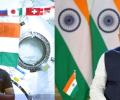
Shukla created history on Wednesday by embarking on a journey to the International Space Station (ISS) as part of a commercial mission operated by Axiom Space, along with three other astronauts.

Vikram and Pragyan payloads are now in a power-off mode until the south pole of the lunar surface is back in the range of the Sun again.

ISRO made efforts to re-establish communication with rover Pragyan and lander Vikram after they were put into sleep mode in September following the onset of night on the moon.
